Josh Reviews You Can See Everything
You Can See Everything is a new film directed by Nathan Fielder and Lance Oppenheim, featuring Elizabeth Holmes and her partner Billy Evans. Much of the film is set in 2023, a month before Elizabeth Holmes has to report to prison to start serving her 11-year prison sentence for defrauding investors in Theranos, her company that promised a revolutionary blood-testing device. Ms. Holmes and Mr. Evans have invited a documentary crew into their home, presumably with the goal of humanizing Ms. Holmes and shifting public opinion back towards her. So the film begins with a set-up that already feels to me like a somewhat strange and dubious proposition… but that winds up being only the beginning of this strange and twisty journey down the rabbit hole…
You Can See Everything is absolutely bonkers, in the best of ways. I was riveted. This is a long movie — around three hours!!! I’d heard there were surprises, and indeed, surprises there are. I went in completely unspoiled, and I strongly encourage everyone reading this to do the same. There are enormous pleasures to be found in watching this movie and seeing the story careen off in new, and completely unexpected directions. I’ll keep this review as light on spoilers as I can. (And if you’re reading this but haven’t yet seen this film, you might want to stop here and go see it, then come back to read my thoughts!)
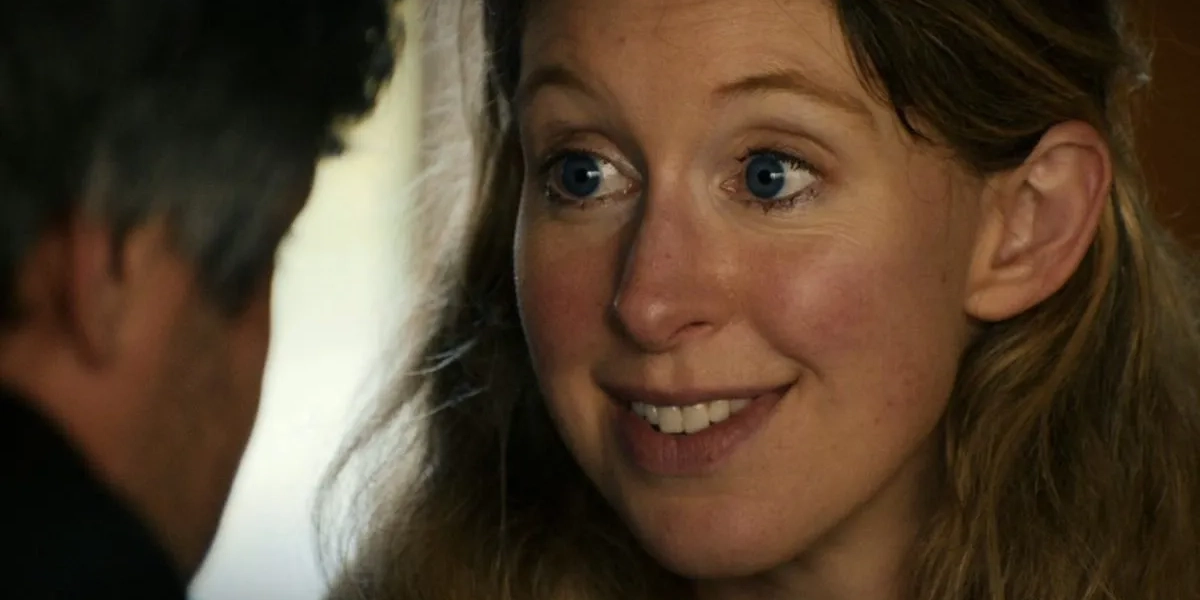
This movie is a fascinating exploration of the quest for truth, something that has grown increasingly difficult in our modern world. There are many scenes in which we see Nathan Fiedler looking into Liz’s enormous eyes, or the eyes of Billy, trying to determine if they truly believe what they’re saying. Are they deluded, or are they sophisticated scam artists? While watching this movie, I kept hearing the Curb Your Enthusiasm music in my head, and thinking of all the times we’d watched Larry David doing the same thing:
The film itself is designed to wrestle with this question of truth. This is a documentary film… or is it? I noticed that on Wikipedia, the film is designated as a metadocumentary, in which ” the film informs the audience that they are watching a work of fiction.” Would the filmmakers agree or disagree with that label? I doubt they’d consider their movie fiction, though they do push the boundaries of what a documentary can be. That’s part of what makes this film so fun and fascinating! For example, the second half of the film playfully employs some reenactments, to convey to the audience what happened in some moments that the team wasn’t able to record. Is what we’re seeing really what happened? These questions also arise when watching the bulk of the rest of the film, when we’re actually watching and listening to the real Elizabeth Holmes and Billy Evans, directly on camera — because even then, it’s hard to know how to interpret their words and actions! Are they telling the truth? Are they liars? Do they truly believe what they’re saying?? The film invites you to engage with this.
From just a few minutes into the film, co-director Nathan Fielder is an on-screen presence. This is unusual but not unheard of for a documentary film; though what is unusual is the way Mr. Fielder keeps getting pulled (or decides to step) further & further into the story. Elizabeth and Billy engage with him, and he engages right back, asking questions and actively trying to get them to reveal more of what they’re actually thinking. A key moment comes very early in the movie, in which Billy grabs a bowl of eggs that Elizabeth is whisking away from her, because he doesn’t think she’s doing it right. Most “fly on the wall” documentarians might have let that moment stand on its own; Nathan interjects and asks Billy why he did that. The result is fascinating, as Nathan often speaks for the audience in asking questions trying to suss out what is really the story between these two. But there are reasons why documentarians don’t usually do this. Does Nathan’s involvement allow us to get closer to the truth, or farther away? What does it mean when Nathan is literally sitting on their bed with the two of them, when he gets them to watch The Dropout, the Hulu TV show in which Amanda Seyfried plays Elizabeth Holmes?? When Nathan turns into a detective in the film’s last hour, is he doing a good job as a journalist, or a poor one? These are fascinating questions!
These are all important parts of what makes this film feel so unique. Possibly my favorite scene is the moment in which Nathan gets the two to watch Abbott and Costello’s “Who’s on First” routine. First off, it’s a sad testament about today’s youth that neither claims to have even heard of Abbott and Costello. But things really get juicy when Nathan interrogates Elizabeth afterwards, and it becomes apparent that she doesn’t at all understand the routine and why it’s funny. Does her brain genuinely work differently than most other human beings’ do? Is it possible that she wasn’t intentionally lying all the time about Theranos, but just not understanding how most people communicate? Or is she a liar, as so many think she is? Or is she a self-deluded lunatic? After three hours watching a film asking these questions, I still don’t know! That’s frustrating, but it’s also exactly the point. (The film’s title is both true and painfully ironic.)
There are so many aspects of the film being debated and discussed online. There’s a striking moment of male nudity early in the film, and there is disagreement between the filmmakers and the subject as to whose idea that was, and how and why that happened. (Click here for more info, though I advise you not to read any articles about the film until after you’ve seen it.) On the one hand, those post-release disagreements feel like a side-story to what the film is really about, but they’re also great examples of EXACTLY what this film is about. Is there the possibility of finding objective truth? Is one person telling the truth and the other lying? Or can both sides really have so profoundly misunderstood the other?
Elizabeth and Billy make a lot of noise, in the film, about one particular quote attributed to Elizabeth in a New York Times profile of her. They claim Elizabeth never said that; they claim that they recorded the entire conversation and can prove that, though they never produce the tapes. The Times released a statement standing by their reporter, though it seems the reporter was working off of notes rather than a recording. (This is an accepted journalistic practice, though I can see how that could allow for the possibility of a minor mistake in a direct quotation.) Interestingly, after seeing the film, I’ve read what that Times reporter has to say. She indicates that Nathan Fiedler and the movie somewhat distort her interactions with them. That’s disappointing to read, as I want to believe that Mr. Fielder and Mr. Oppenheim, in their quest for “truth”, are operating without reproach. But is it wrong to jump to believing that what the reporter writes and remembers is 100% the “truth”?? These are wonderfully thorny questions!!
The subject matter of this film — a disgraced liar prepares to go to prison for a decade — might lead you to think this film will be dour. That plus the three-hour run-time might keep some away. Don’t let that let you! I found this film to be both serious and moving while also being a lot of fun. I laughed a LOT while watching this. And the story’s twists and turns will keep you engaged, I assure you. Part of the fun of the film is watching this story unfold; I was continually surprised. Characters say and do some unbelievable things in this movie. It’s a wild ride.
Go see this! See it with an audience on a big screen! This is a wonderful film… and don’t you want to be in on the conversation?? I did, and I’m so happy that now I am.
Thanks for reading! Please support my website by clicking through one of my Amazon links the next time you need to shop! As an Amazon Associate, I earn from qualifying purchases. That means I’ll receive a small percentage from ANY product you purchase from Amazon within 24 hours after clicking through. Thank you!