Josh Reviews VisionQuest
The latest Marvel Disney+ TV series, VisionQuest, finally brings back Paul Bettany as the Vision. In case you don’t remember, the heroic Vision was murdered by Thanos in Avengers: Infinity War, then resurrected (sort of) in the fake TV-show reality that Wanda created for herself, to hide from her grief, in 2021’s WandaVision. That resurrected-by-Wanda Vision was confronted the white Vision, constructed from the original Vision’s corpse by S.W.O.R.D., but without the Vision’s heart and soul. Eventually the white Vision’s memories were unlocked and he flew away, while the resurrected original Vision faded back into oblivion once Wanda ended her magical control over the town of Westview. (Everybody got all that??)
After the white Vision flew off in the WandaVision finale, we never knew what happened to him. It’s been a long wait for an answer to that question, but VisionQuest was worth the wait. The series, overseen by Terry Matalas (poached by Marvel after he helmed the fantastic third season of Star Trek: Picard) gives Paul Bettany’s the Vision the spotlight he’s long deserved.
VisionQuest is a fantastic show. I loved all eight episodes. The show is fun and exciting, with rich character exploration. I love the cast of characters they’ve assembled, pulling together a fun array of characters from the MCU’s deep bench of continuity while also introducing a number of great new additions. VisionQuest is a satisfying conclusion to the very strange, unintended trilogy of WandaVision, Agatha All Along, and now VisionQuest. Like Agatha All Along, this show feels like minor-key Marvel. This show doesn’t feel as important to the overall MCU saga as the earliest Disney+ shows were (shows like WandaVision, The Falcon and the Winter Soldier, Loki, etc.). But I loved it all the same! This was a thoroughly entertaining series. If you’ve tapped out of the Marvel Disney+ shows (and I completely understand if you have), it’s worth checking back in for this one. I suspect that if you liked Wanda and the Vision in the earlier MCU projects, you’ll enjoy this show. (And don’t worry about the complicated continuity I summarized above; while this show has lots of continuity connections to please long-time fans, it stands on its own nicely and doesn’t require extensive MCU homework to enjoy.)
I loved this show and I’m excited to dig in. There will be a few very minor spoilers in this review; nothing beyond what you’ll learn in the first episode, but if you haven’t seen anything of this show yet and you want to go in totally unspoiled, please be aware. (I will have a more detailed SPOILERS section that will be marked at the end of this review.)
Paul Bettany was fantastic as the Vision right off the bat, from when he was first introduced in Avengers: Age of Ultron. I’ve missed his presence in the MCU post-WandaVision, so it’s a pleasure to have him back here. Mr. Bettany is a phenomenal actor, and he does a terrific job portraying the emotional journey that the Vision goes through here on this show, moving from claiming that he is without feelings, to embracing his emotions and his ability to feel love. Mr. Bettany is among an elite cadre of actors who have created iconic performances portraying robotic and/or emotion-less characters but still bringing so much life and soul to them. His Vision stands tall with characters like Data and Spock. (The Spock comparison is the most apt. True Trek fans understand that it’s not that Vulcans don’t have emotions, it’s that they sublimate them. Watching this show, it was clear that Mr. Bettany understood that while Vision claimed to be without feelings, that was not at all the case. This shined through in the beautiful subtleties of Mr. Bettany’s performance.) (By the way, I thought about Star Trek a lot while watching this show, knowing of Terry Matalas’ Trek bona fides. But never more so than when the show allowed Mr. Bettany to do what Star Trek did so enjoyably with Brent Spiner, who played multiple androids as well as their aged creator, Dr. Soong. Here, I loved that we got to see Mr. Bettany not only play his synthezoid predecessor, Jim, but also Jim’s creator, Dr. Phineas Horton! That was so fun!)
I was so excited when I read that James Spader would be returning as Ultron (for the first time since his introduction in Age of Ultron). But I was not prepared for the degree to which Mr. Spader would steal the show. I adore the way Terry Matalas and his team have written Ultron here — he’s absolutely still dangerous and villainous, but he’s also delightfully droll and bitingly humorous, and he’s layered with both keen awareness and also self-delusion. This is a gorgeously well-written role, and Mr. Spader absolutely crushes it; his presence dominates the screen whenever we see him. What a triumph. I loved this version of Ultron!!
I really enjoyed the show’s idea to make this series not just about Vision and Ultron, but to bring together an array of A.I.s we’d previously seen in the MCU. First off, we got Jarvis (or, I guess I should write J.A.R.V.I.S.), played by James D’Arcy (reprising his role as the human Jarvis from the Agent Carter TV show; he was also briefly glimpsed in Avengers: Endgame — Paul Bettany voiced the A.I. Jarvis in Iron Man and the other MCU films; but because Mr. Bettany is now playing the Vision, it made perfect sense to bring back Mr. D’Arcy for Jarvis). Then there’s F.R.I.D.A.Y. (first introduced as Tony Stark’s A.I. replacement for Jarvis in Age of Ultron, where she was voiced by Kerry Condon; she continued to voice Tony’s primary A.I. assistant in various other MCU films through to Endgame). Here, Friday is played by Orla Brady (who played the Romulan Laris in Star Trek: Picard). I quite like Ms. Brady’s performance (even though she doesn’t sound anything like Kerry Condon); I like how smart and brave this Friday is. I loved the scene the show gave her, exploring her grief at being unable to save Tony Stark from death in Endgame; that was a beautiful moment. Next is E.D.I.T.H., first introduced in Spider-Man: Far from Home (where she was voiced by Dawn Michelle King). Here she’s played by Emily Hampshire (Stevie Budd from Schitt’s Creek!), who is a ray of sunshine whenever she’s on screen. I love the innocent joy that Ms. Hampshire gives to Edith. I also love all the fun costumes she gets to wear, each time she’s helping out in a different way or through a different scenario!! (Watching her drop down from the ceiling, Mission: Impossible style, was my favorite.). But that’s not all! We also got to see D.U.M.-E. and U., the two silent, simplistic A.I.s in Tony Stark’s workshop back in the original Iron Man!! Here they’re played by Henry Lewis & Jonathan Sayer, who both do a great job.
But there are still more A.I.s included in this show! Right from the first episode, when the camera lingers on a painting of the original Human Torch, it was clear that the show would also be involving the MCU’s original android/synthezoid, the robotic Jim Hammond (glimpsed at the World’s Fair in Captain America: The First Avenger!!), which made me so happy. And they also found a way to introduce Jocasta, who was a character I’d enjoyed from the Avengers comics in the eighties and nineties. She was originally introduced as “the bride of Ultron” in the comics, and I loved the clever way the show managed to weave that aspect of her character into this version of her. Here, Jocasta is played by T’Nia Miller, who brings a delightful energy to the role! I loved this version of Jocasta, who is dangerous and sexy and curious.
The show does have some non-A.I. characters! I was happy to read that Terry Matalas was bringing along his friend Todd Stashwick (who appeared in Mr. Matalas’ 12 Monkeys show, and was so memorable as Captain Shaw on the third season of Star Trek: Picard), who plays Paladin. Wow, the bounty-hunter Paladin!! I never expected to see this character in live-action!! (Personally, I most remember Paladin from the Assassination: Nation storyline in The Amazing Spider-Man comic-book series in the eighties, written by David Michelinie with art by Todd McFarlane and others.) I loved Mr. Stashwick’s interpretation of Paladin — smart and dangerous, but also funny. I like how things are never personal with Paladin; he’s just a (violent) businessman, so when it makes sense for him to switch sides, he does so with ease. This is a great character; I’d love to see him again!! (I also smiled that the show occasionally allowed Paladin to wear his comic-book googles; though they did look a little silly. I though Paladin on the show was cooler without them.)
With one of Wanda and Vision’s twin children, Billy, appearing in Agatha All Along, it makes perfect sense that VisionQuest would bring in their other twin, Tommy. The grown-up Tommy is played by Ruaridh Mollica, who does a great job playing this tortured character. I like that the show doesn’t shy away from the complicated backstory of Vision and Wanda’s kids, instead leaning into that and showing us how hard it is for Tommy to understand what’s happening with the two lives blended inside his head. (Agatha All Along sidestepped that somewhat, by telling us that the kid whose body Billy was inhabiting had died, so now only Billy’s presence was there. Here, they make the interesting but more-complicated choice to suggest that Tommy just got close to death in the pool, but didn’t actually die, so now the original Thomas Shepherd AND Tommy Maximoff are both having to co-exist in the same mind/body. Weird!!)
Lauren Morais does a nice job in bringing life to a character who might easily have been boring. She plays Lisa, Tommy’s crush and partner-in-cons. I like Lisa and I liked the way the show depicted her & Tommy’s friendship. She briefly becomes the damsel in distress, which I didn’t love, but then they also let her kick ass as a sort of superhero of her own by the end, so that was nice. (Though the show probably didn’t want me to be thinking about Superman III as much as I was, when Lisa gets infected by nanites and briefly turns into some sort of machine-woman…) Diane Morgan (Philomena Cunk herself!) is wonderfully droll as Paladin’s woman-in-the-chair, helping him on his missions through his ear-piece. Here too is a role that might have been boring, but Ms. Morgan’s snarkiness made her a joy whenever she was on-screen.
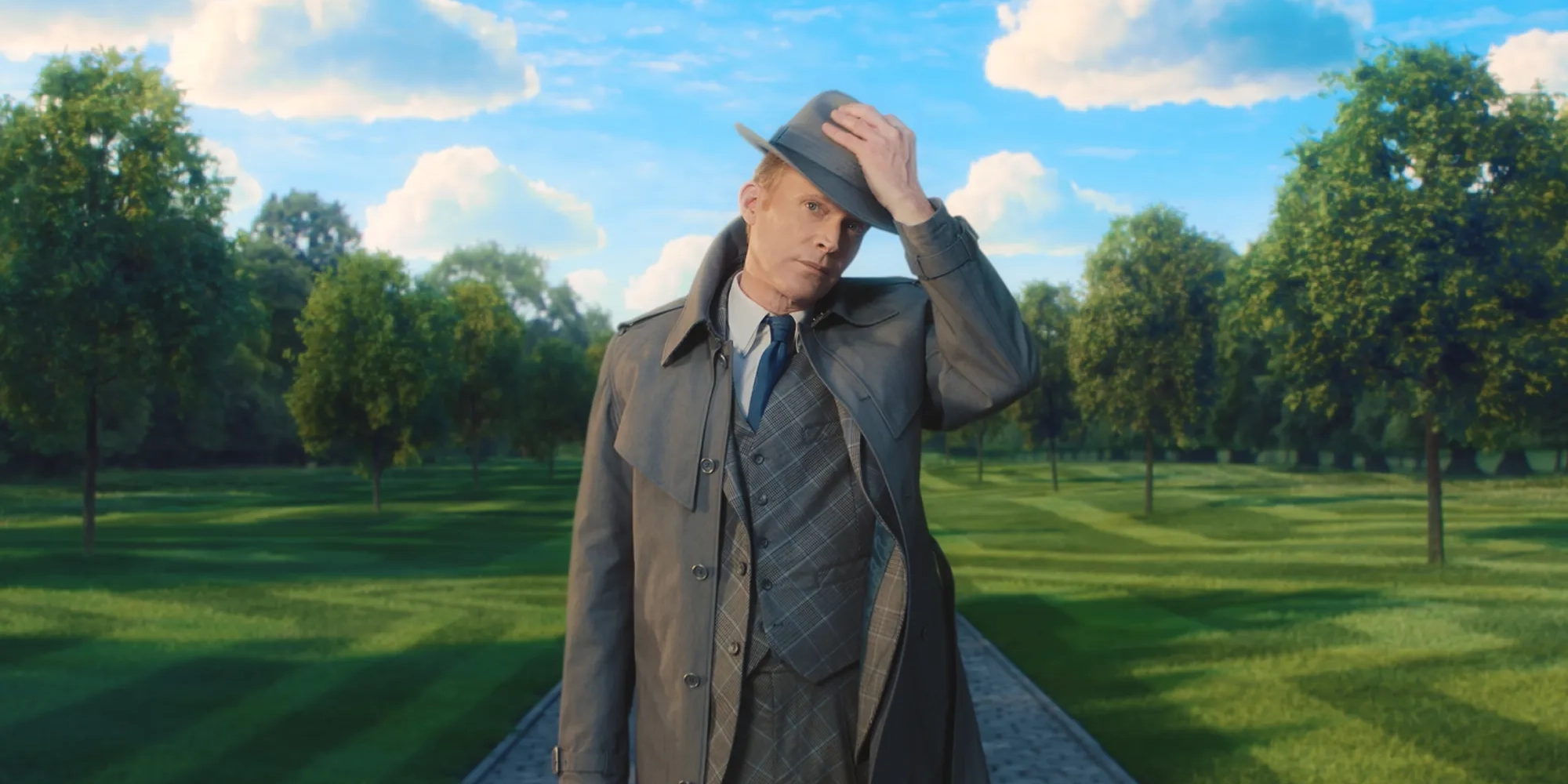
I loved the way the show depicted the mind-space inside the Vision’s head, from the delightfully strange-looking exterior of the house they were all living in, to the colorful, retro look to the interiors. This allowed the show to have a ton of playfulness in how they portrayed the complicated techy goings-on inside these A.I.s. Instead of boring tech-looking locations, we mostly got retro-looking scenes of old-fashioned phones and filing cabinets. For example, I loved the scene in which Vision and Ultron were depicted as old-fashioned gumshoes when trying to get past some A.I. security bots and their security questions. The show also did a great job in the way it portrayed these robotic characters as human avatars. It didn’t feel like a cheat, for instance, that we were mostly seeing Ultron in the form of James Spader, as opposed to as a robot. First off, the show did show us plenty of the robotic Ultron (and Jocasta, etc.). Also, when you have a performer as amazing as James Spader, I was always happy to see him on screen!! This worked for me!
OK, let’s dig a little deeper into SPOILER territory to talk about the finale, and a few other aspects of the show. BEWARE SPOILERS ahead!!
The following SPOILER-filled sections of this blog are for paid subscribers of my Substack: Edelglass Half Full. Click below to sign-up and join the fun!