Josh Reviews Beam Me Up, Sulu!
Back in 1985, a young Star Trek fan named Stan Woo set out to make a Star Trek fan film… and he somehow convinced George Takei to participate, playing Mr. Sulu! The lovely documentary Beam Me Up, Sulu, directed by Timour Gregory & Sasha Schneider, explores the crazy story of how this happened, and the twists and turns of what happened next. (Turns out the film sat lost and unfinished for almost forty years, until fellow Trek fan John Atkin helped complete the film in 2022!)
This sweet documentary is a love-letter to George Takei, to Star Trek, and to the creativity and ingenuity of fans everywhere. I had a lot of fun watching this.
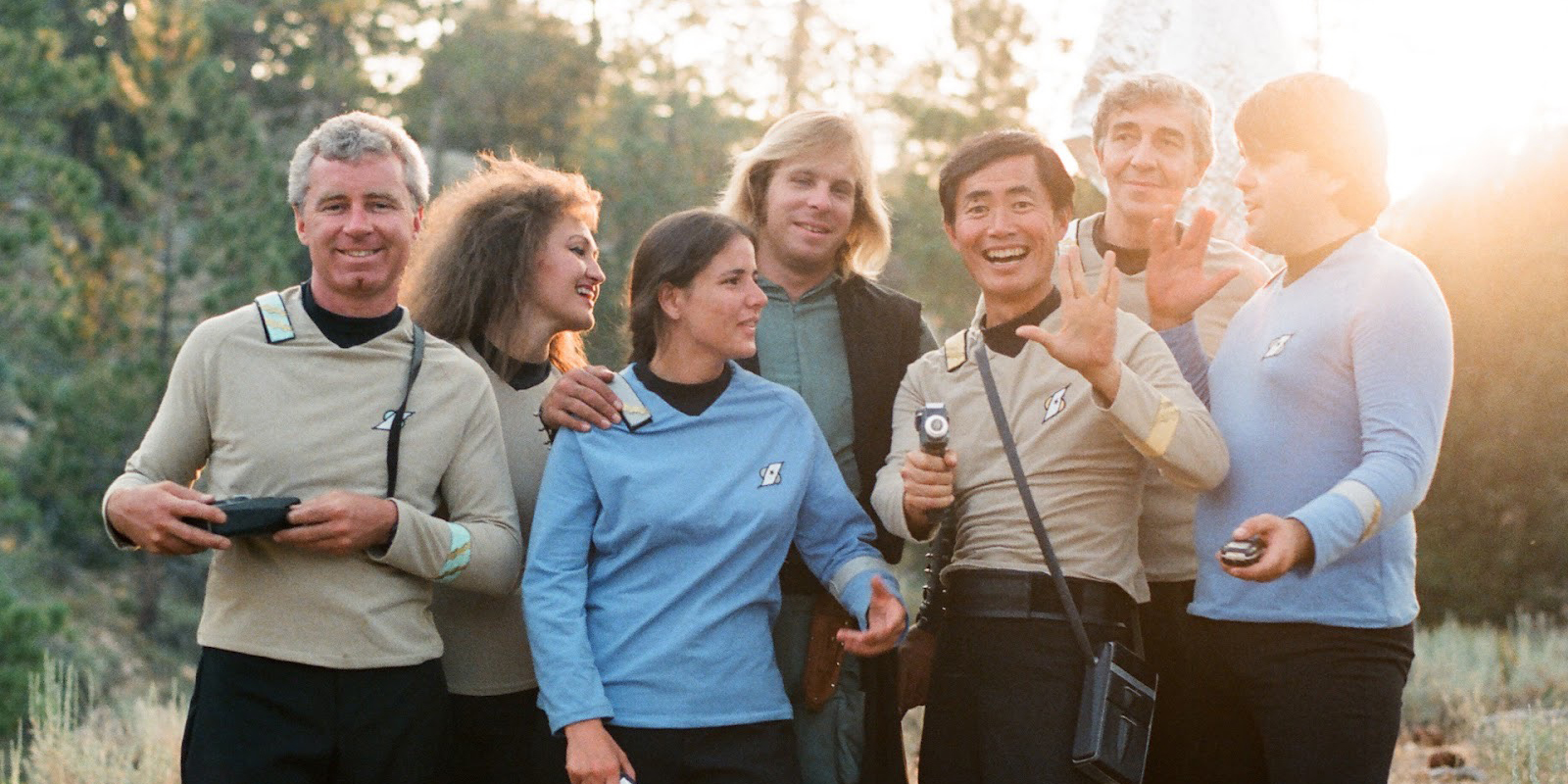
It’s pretty wild to think that George Takei, in between playing Sulu in Star Trek III and Star Trek IV, agreed to play the character in a small student film! It’s truly a credit to Mr. Takei, and his desire to give back and help film enthusiasts and students in general, and also his specific desire to help Stan Woo as a member of the Asian-American community, all of whom faced significant struggles in getting a foot into the Hollywood door in those days. I think this is very cool. My favorite parts of this documentary are the behind-the-scenes footage of Mr. Takei on location with Stan and his gang, shooting their film Yorktown: A Time to Heal. Seeing Mr. Takei smiling and laughing together with these kids is so lovely. What a mensch!
The film allows us to get to know Stan Woo, and follows him on his crazy dream to make a Star Trek fan film. We get to see how the idea was generated, how he set about gathering his collaborators, and how he got stars like Mr. Takei, along with James Shigeta, to participate! (Mr. Shigeta was an early Asian-American superstar actor in Hollywood, who is probably most familiar to film fans these days as Takagi in Die Hard, but who also appeared in a host of films, including Paradise, Hawaiian Style with Elvis Presley.) We get to see footage of the film’s production, and then learn about how it was left unfinished for decades, until John Atkin, who had read about the project decades earlier in Starlog magazine (how I loved Starlog as a kid!! It was my main pre-internet source of news on sci-fi film & TV projects back in the day!), stepped in to take the lead on completing the film’s editing, color-timing, and visual effects. (He even acts in the film briefly, in one of the scenes that they never got around to filming back in the eighties.)
The film also explores the history of Star Trek, and why it was important. We get to hear from a number of actors who have been involved with different iterations of Star Trek over the years, including George Takei and his husband Brad Takei, Alexander Siddig (Dr. Bashir on Deep Space Nine) Garrett Wang (Ensign Kim on Voyager), and Christina Chong (La’an Noonien-Singh on Strange New Worlds), as well as many others who were inspired by Star Trek. They all talk about the impact of Gene Roddenberry’s utopian vision, and specifically about the importance of how Star Trek has incorporated diversity and representation on-screen. It was revolutionary to see a man of Japanese descent, an African American woman, and a Russian, all working together on the bridge of the Enterprise! I was moved hearing about how powerful it was that an early Star Trek episode included a moment in which Kirk apologizes to Uhura for losing his temper. It’s easy to forget how earth-shattering it was to see a white man in authority apologize to an African American woman on TV in the sixties. I was also interested to hear Mr. Takei describe how proud he was that he was allowed to play Sulu without a cliche accent. (Unlike Scotty and Chekov!)
Future Star Trek shows continued to move forward in this representation, which is one of the things I love best about Trek. I found it powerful to hear Alexander Siddig talk about how refreshing he found it that not only did his “Arab” background not at all impact how his character of Julian Bashir was written, but also how thankful he was that Deep Space Nine was one of the few times in his career he wasn’t asked to pray on-screen as part of his role.
This discussion of Star Trek’s leadership over the decades in on-screen representation is one of the most interesting and important aspects of this documentary, in my opinion. The film gives a lot of time and space for Mr. Takei and a number of other Asian American voices to talk about the effects of the lack of representation of Asians on screen. For so many decades in Hollywood, Asian-Americans almost never saw themselves on-screen, and when they did, they were never in central roles, never in roles that young people could look at and see something favorable in. They were just stereotypes and side characters. The film argues that this void in representation leads directly to the racism against Asian-Americans that is sadly still present today, and how that hatred and discrimination leads further to the huge recent upsurge in violence against Asians. (We see a number of painful clips of examples of racism and violence against Asian-Americans, including President Trump mockingly calling Covid the Asian flu.)
The film also takes the time to explore George Takei’s life and career. In some of the film’s most powerful sections, Mr. Takei describes how he and his family were incarcerated for FIVE YEARS in internment camps for Japanese Americans, put into prison camps surrounded by barbed wire. (This awful chapter in Mr. Takei’s life, and in American history, was explored in Mr. Takei’s incredible graphic novel They Called Us Enemy, which I highly recommend.)
The film also takes other digressions, exploring Star Trek fans and fandom, as well as the whole idea of Star Trek fan films. I enjoyed these sections. I was glad the film emphasized the passion and creativity and inclusivity of Star Trek fans (and how the whole idea of conventions and cosplaying originated with Trek fans), without poking fun at these people. I also enjoyed the brief look at other Star Trek fan films. (I was, though, disappointed that Star Trek: New Voyages only got a super-fast two-second appearance on-screen, and Star Trek Continues was left out entirely. I feel that those two projects were among the very best Trek fan films. I really was surprised that New Voyages wasn’t mentioned at all, because George Takei also appeared as Sulu in that fan project as well, decades after Yorktown!! That New Voyages episode, “World Enough and Time”, is a high-point of all the Trek fan-film projects. It’s obviously a fan-made effort, involving a mix of professionals and amateurs, but it’s produced with such skill, craft and love, that it really is watchable as a Star Trek episode!! You can still watch it on YouTube!) Getting back to this doc, I loved hearing a lawyer on-screen discussing the legality of fan films. (Someone please tell Paramount, who a decade ago used draconian methods to crush many of the best Star Trek fan projects, including Axanar.)
If the film has a weakness, it’s that it felt to me like there was probably only about an hour or so of truly central content to this story. As we entered the film’s second half, I got a little restless at times, feeling like the film was taking a lot of digressions, perhaps to fill out the run-time. Some of the digressions were interesting (I’ve just spent several paragraphs praising various sections of the film that were not directly connected to the story of the making of the Yorktown fan film), but some felt like more of a stretch. I also felt the doc jumped over some of the details of the fan film’s original production that I’d have loved to have seen explored more deeply. How did they create all the sets, props and costumes? I was impressed by what I saw, and how screen-accurate everything looked to TOS. We see a prop phaser, for example, that looks fantastic. How were all those acquired or made? Where did they film the interior scenes? How did they get, for example, chairs that look just like classic TOS chairs? I’d have enjoyed more exploration of that.
Still, over-all, I feel that Mr. Gregory & Ms. Schneider have assembled a lovely product here. (And I haven’t even mentioned the clever and fun animated sections, which help bring aspects of the story to life when there wasn’t actual footage of the events being discussed. The animation was created by Gazelle Automations, and designed to mimic the classic Filmation style of Star Trek: The Animated Series from the seventies. That was a nice touch.)
At one point, Stan Woo calls his Yorktown project ” like a fanzine but in celluloid.” That’s a beautiful description. You can watch Yorktown: A Time to Heal here on YouTube. That’s probably just for the hard-core fans. But this lovely documentary can be enjoyed by anyone. It’s available for purchase or rent on Amazon Prime Video.
Please support my website by clicking through one of my Amazon links the next time you need to shop! As an Amazon Associate, I earn from qualifying purchases. That means I’ll receive a small percentage from ANY product you purchase from Amazon within 24 hours after clicking through. Thank you!